
6
by viqaiq
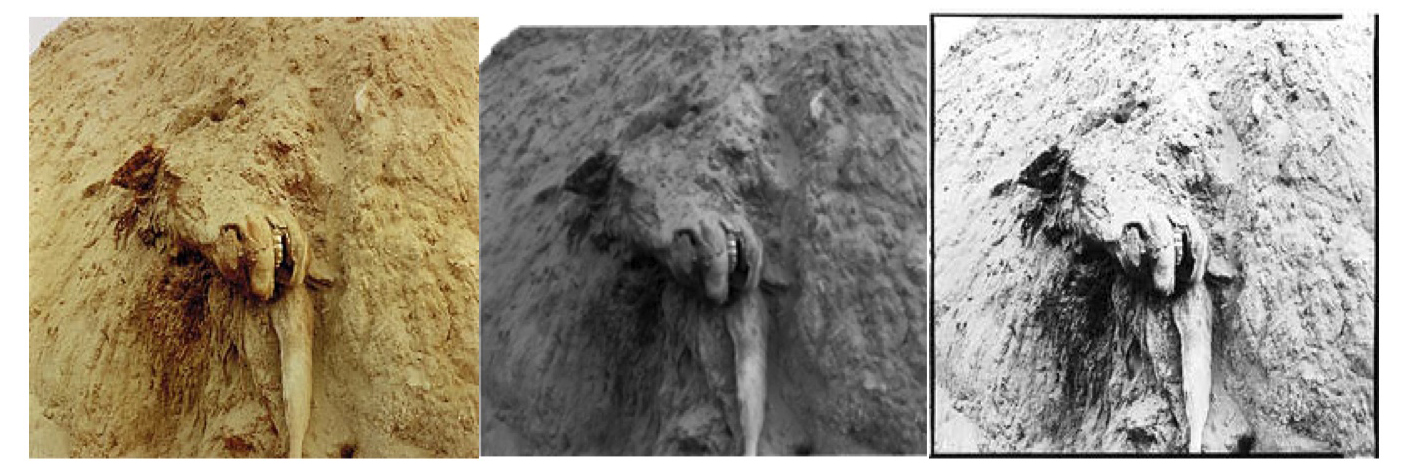
Q. What happens to our understanding of an image when it is reproduced?
A. Here are three versions of the same photograph by Richard Misrach (two of them were taken from museum websites). For anyone who hasn’t seen the original (most closely represented by the image on the far left) it would be impossible to tell which of these reproduced images is most “true”.
In his series Desert Cantos, Misrach makes plain for us the results of nearly 30 years of illegal bomb testing on the Nevada landscape. Our ability to grasp the gravity of Misrach’s work is also affected by seeing it in such tiny form. Nothing can come close to seeing this photograph in the original among the other photographs in this series.
Reproduction fundamentally alters images in significant ways and can affect our ability to understand what we are seeing. The size, scale, and other critical information (like color, texture and dimension) can be lost in translation. We are also frequently shown details of larger works (instead of the entire work of art) which also interferes with our ability to critically evaluate what we are seeing. Mass production and the transfer of fine art images to coffee cups, tote bags and greeting cards can also alter our relationship to the original work by turning art into something that is simply decorative and not about an idea. As critical viewers it is important to consider how a work can be changed through reproduction and to understand that the experience of seeing an original may be an altogether different experience.
The painting below, Newly Displaced Population by Liu Xiaodong from the The Three Gorges Project, measures 33 ft. by 9 ft. The size of this painting is central to its meaning; it is an enormous painting about an enormous transformation with enormous historical, political, environmental and personal impact. Much of the power and meaning of this painting is simply lost when it is seen in this small size.

 viqaiq.com
