100 Questions Designed to Boost Your Visual/Arts Intelligence Quotient

21

Q. What do you do when you don’t understand a work of art?

A. Art can seem inaccessible and even with a lot of experience it is possible to be stumped at times. You might try a system of “backing up” to get a handle on things you don’t understand. Start by reading the title of the work to see if it helps orient you and then try looking at other pieces by the same artist (very important). If this doesn’t help, see if you can find an interview with the artist or a review of their work. You may also want to look at work created by similar artists at about the same time. This may require extra effort but it will, no doubt, help you better access things that are complex and challenging. There can be, by the way, much pleasure in viewing things that are mysterious. It is not always necessary to have a literal understanding of everything you see to enjoy and appreciate it and many works of art may remain just a bit out of reach for all of us.

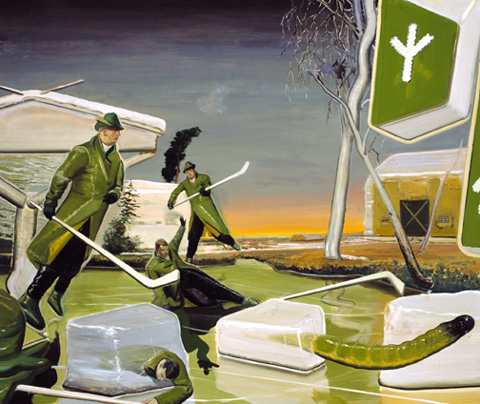
This is the work of Neo Rauch whose paintings resist and defy both literal and symbolic understanding. According to Gregory Volk, Rauch himself indicated in conversation that he includes figures in his paintings simply “because the picture requires it, in really formal terms: color, balance, scale and proportion” making an attempt to understand his characters rather futile.

22


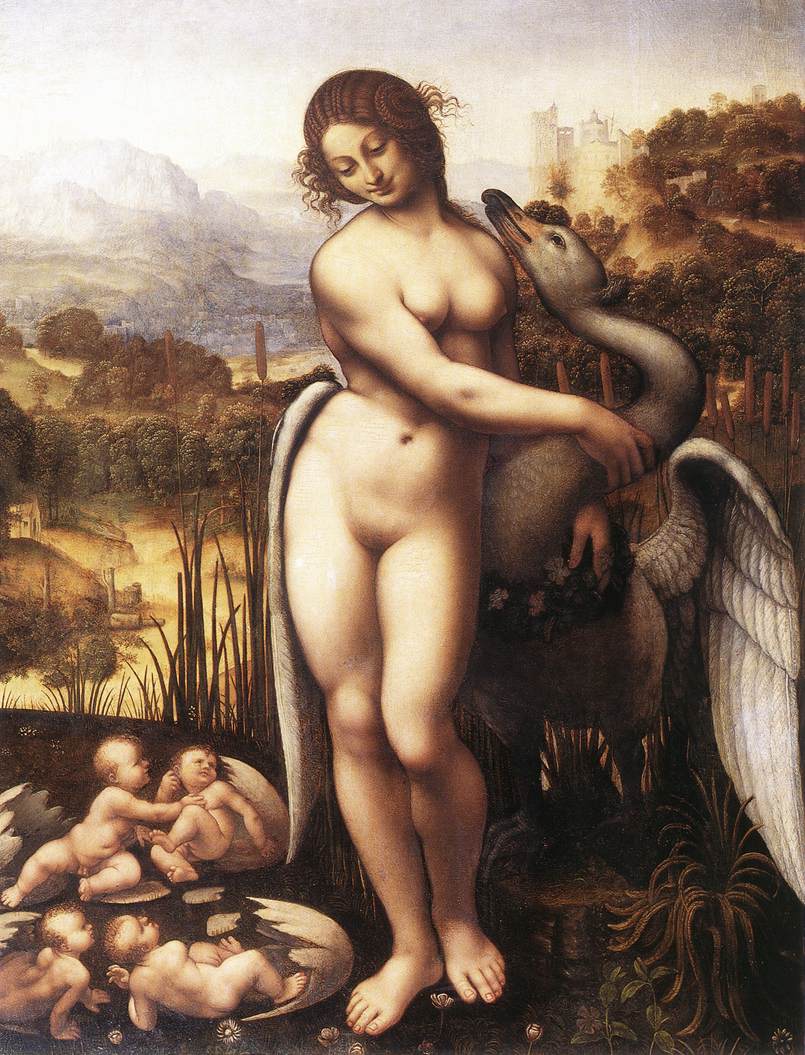
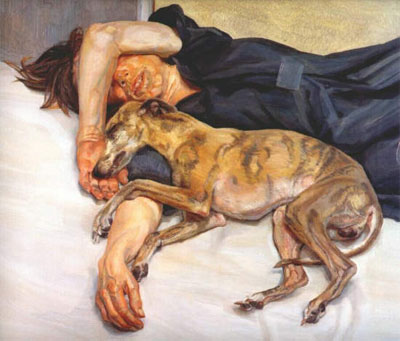
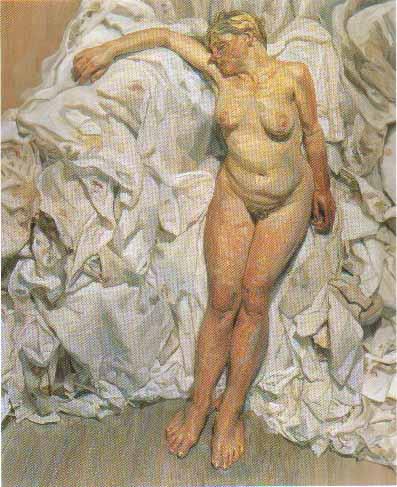
Q. The painter Lucian Freud was said to have admired the work of Titian, Cardin and Courbet and to have disliked da Vinci, Raphael and Vermeer. Take a look at the top painting (Courbet), the middle painting (Freud) and the bottom painting (da Vinci). On what do you think Freud based his preference?

A.  According to the writer Martin Gayford, Freud liked the way they painted flesh, faces and bodies and disliked “idealized” versions of the human form. Both Courbet and Freud’s nudes  are “fleshy” and look like real women as compared to da Vinci’s nude which is perfectly proportioned (more divine really than human). Part of Freud’s genius as a painter is the natural, expressive, and realistic way he painted the nude body. It would follow that he admired other painters who did the same.

Lucian Freud also happened to paint dogs with the same kind of expressive realism. He treated animal and human form similarly.

The paintings below are by the well-known contemporary figurative painters Eric Fischl, John Currin and Lisa Yuskavage. Each is provocative in their treatment of the female form and each has distorted their forms for various reasons. What body types are they referencing – models, athletes, porn stars, renaissance goddesses, or nymphs? How do you think these references are related to meaning? What positions are these bodies in – natural or unnatural? What do you think each is communicating through their depiction of the female nude?

23

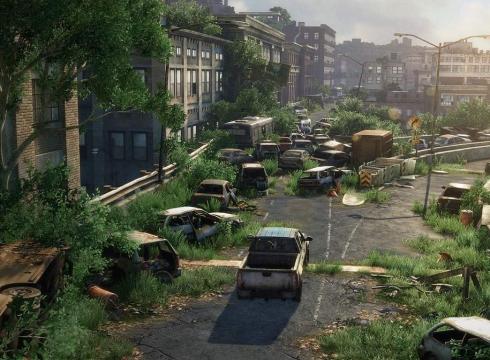
Q. In what museum do you think this work of art is displayed?

A. This is a bit of a trick question since this is a screen shot from Naughty Dog’s video game The Last of Us.

Recently, the Supreme Court ruled that video games are art and deserve the same first amendment rights as other art forms.

Quoting from the court’s decision,

“Like the protected books, plays, and movies that preceded them, video games communicate ideas — and even social messages — through many familiar literary devices (such as characters, dialogue, plot, and music) and through features distinctive to the medium (such as the player’s interaction with the virtual world). That suffices to confer First Amendment protection.”

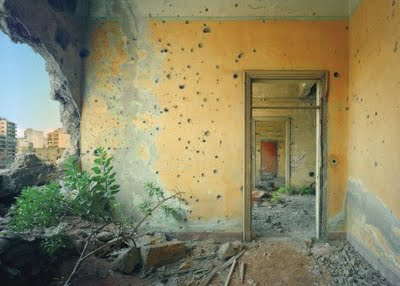
The Last of Us is a survival game set in a surreal, often disturbing and sometimes strangely beautiful post-apocalyptic landscape. Documentary and fine art photography has changed our understanding of and relationship to landscape. A huge range and variety of images of war, natural disaster and environmental degradation and collapse are now deeply rooted in our collective conscious. It is not hard for us to conjure up definitive images from 9-11, Katrina, the tsunamis in India and Japan, or even of more distant but always resonate images from Hiroshima, Nazi death camps or even Vietnam. Features of these destroyed landscapes appear more frequently in a variety of art forms, in video games, for example, and in the constructed landscapes of films like Silent Hill, I am Legend, Contagion, Children of Men and The Road.

Many fine art photographers have worked in a wide range of destroyed landscapes.  Note below the similarities between screen shots from The Last of Us and photographs by Robert Polidori of Pripyat after the Chernobyl disaster. The chilling difference, of course, is that the images in the game are of a city after a virtual disaster and Polidori’s photographs are evidence of real disaster. Perhaps this is the compelling nature of the game. Since these landscapes now seem eerily familiar, do we, on some level, view the game as preparation for what we have come to believe is inevitable? Video games are a particularly interesting art form since our interaction determines outcome – a feature that is likely to be transferred to many other forms of moving image experiences in the future.


24

Q. What is the enemy of art?

A. Most people would agree that the most serious enemy is censorship. Threats to artistic expression of any kind are intellectually dangerous as they can ultimately infect all forms of free speech.

The image above is from a short video entitled Fire in My Belly by the artist David Wajnarowicz which was at the center of a major censorship controversy this year. The video was removed from a show entitled Hide/Seek at the National Portrait Gallery in Washington D.C. after complaints from the Catholic League and conservative Republicans. Wajnarowicz’s video includes a short clip of ants crawling on a crucifix, and although this work is widely understood as dealing with the suffering associated with AIDS, conservatives succeeded in having the work removed from the show. Many artists and leaders in the art world were outraged by the Smithsonian’s response to conservative pressure and many staged protests against the decision to remove the work. Probably the most inventive of these was initiated by Mike Blasenstein who wore an ipad on his chest playing Fire in My Belly while he stood inside the museum.

The Chinese artist, Ai WeiWei has been regularly censored by the Chinese government. His studio has been destroyed several times, his blog has been repeatedly disrupted and censored, and he was recently imprisoned on groundless charges of tax evasion.

Artists are often caught up in culture wars by the simple fact that they push our cultural, social, and aesthetic limits and in doing so they may directly or indirectly push the political envelope. Their work can also be used by others for political messaging, which may or may not have anything to do with the nature of their work. It is not hard to understand why creativity and creative expression can be viewed as subversive since the imagination is all that is needed to envision change. The hard part is honoring and protecting the right to personal expression of all kinds.


25

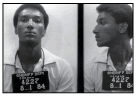
Q. This mug shot played a critical role in convicting an innocent man to life plus 50 years in prison. Who is this man and how did this mug shot change the way police conduct suspect identifications?

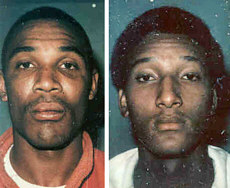
A. This is a mug shot of Ronald Cotton, a man wrongly convicted of rape in 1984. The victim positively identified Cotton based on his very distinct facial features (a long thin nose and high eyebrows). While Cotton was in jail, inmates began to confuse him with another man, Bobby Leon Poole, as the two men looked very similar. Cotton began to suspect that Poole was the real attacker and DNA tests later confirmed that Cotton’s suspicions were correct. The victim identified Cotton from a mugshot because he resembled her attacker, however, she selected him from a group of photographs of men who did not also have the distinct facial features she remembered. She inadvertently transferred Poole’s facial characteristics onto Ronald Cotton because his was the only mugshot she was shown of a man with a long thin nose and high eyebrows. In the state of North Carolina, police must now show witnesses lineups of individuals with comparable facial features and must indicate that mug shots may or may not include the suspect. For more on this case read Picking Cotton by Jennifer Thompson-Cannino and Ronald Cotton.

Below, comparative mug shots of the actual attacker Bobby Leon Poole (on the left) and Ronald Cotton (on the right).

A significant and growing area of research is being done on the practice of suspect identification. It turns out that visual memory is not as reliable as we think. We may merge memories, transfer details, omit details, focus on the trivial, or have difficulty making distinctions between like things after the fact. For example, we may remember that a getaway car was blue but it might be hard for us to pick out the right make and model when we have a range of blue cars to choose from. Memory can be affected by age, fatigue, predisposition to events or people, and traumatic and casual events are remembered with different levels of clarity.

Cases like the one above have had a major impact on the way law enforcement approaches suspect identification. There are a number of simulated eyewitness tests that have been developed which assess visual memory (one is available at the Picking Cotton website). If you have the time, test your ability to identify a suspect, the results may surprise you.

26

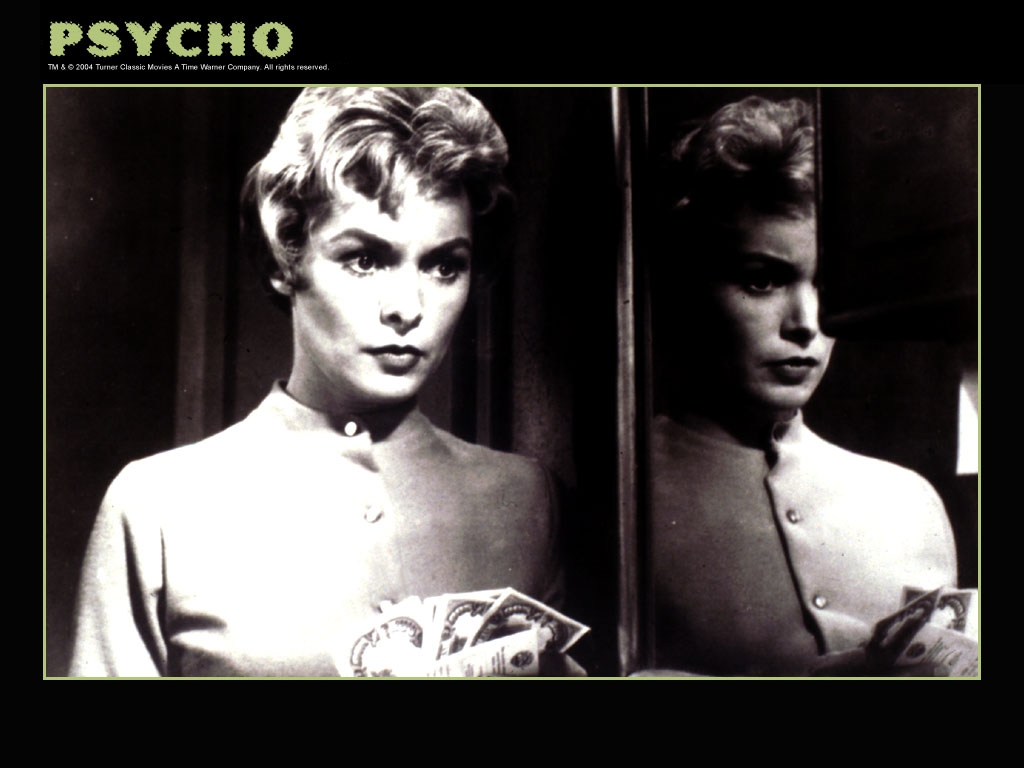
Q. Take a look at this face above and the two faces below. Is this the same man?

A. It is the same man. Faces are not symmetrical as these photos demonstrate. The face on top is the two merged right sides of the face, and the face on the bottom is the two merged left sides of the same face. This image is taken from the Psychobox: A Box of Psychological Games. The editor, Mel Gooding, points out that Hitchcock used this effect in the film Psycho to emphasize a moment of personal and moral ambivalence. We are shown one face that looks like two because this woman is wrestling with herself and because Hitchcock wants us as an audience to also become deeply uncertain about her.

There are also other ways facial asymmetry can be used for visual effect.

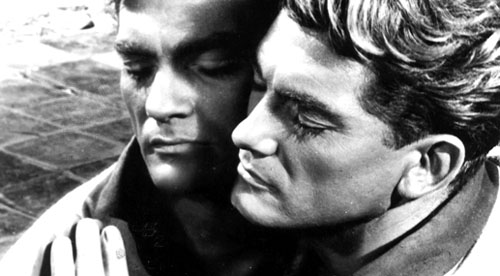
See below a still from the Jean Cocteau’s famous film Orpheus based on the Greek myth. In Cocteau’s modern version of the story, the poet Orpheus must retrieve his wife Eurydice from the underworld (which is accessed by way of a liquid two-way mirror) without turning back to look at her. In the shot below, Orpheus caresses the mirror (or portal) in his longing to reach the underworld. Cocteau is playing with Orpheus’ overwhelming urge to look by turning him momentarily into Narcissus gazing at his own reflection (and with the dual features of life and death, reality and dream, temporality and permanence, etc.). If Orpheus is unable to control the selfish urge to look, he will lose Eurydice forever, and will ultimately end up alone, gazing only at himself. It is also important to note that Cocteau’s imagery here is, in part, homoerotic and that he was celebrating the beauty of Jean Marais, his longtime companion, lover and star of his films.

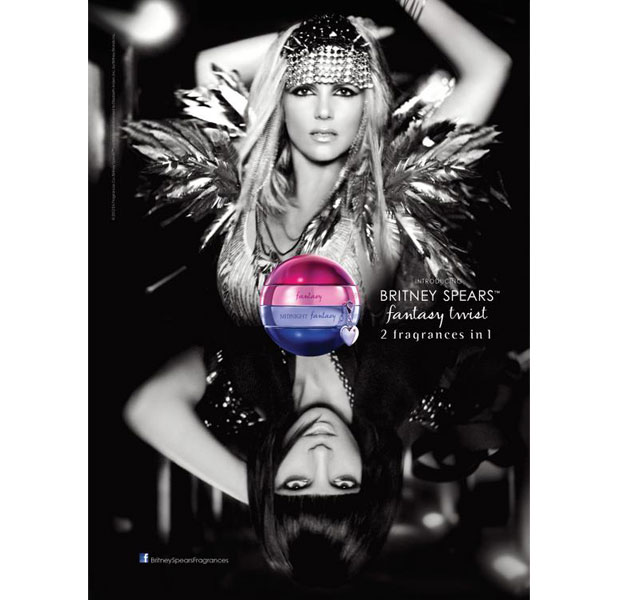
Even Brit Brit has used this wonderful effect. See below her alternate female identities – one light and one dark, one soft and one hard, and one blond and one brunette Britney.

27

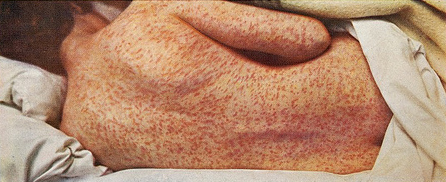
Q. Does this child have the a). chicken pox b.) measles c.) heat rash or are they d.) having an acute allergic reaction?

A. According to pediatric dermatologists, this child has the measles. Physicians have special training and experience in visual examination which allows them to recognize and distinguish the signs and symptoms of illnesses that may look alike. There are many professions that require exceptional visual skills, for example, every kind of scientist, police officers, electricians, engineers, architects, builders, all kinds of inspectors, and there are probably good reasons why air traffic controllers still sit in a tower that overlooks the runway. An intelligent and well-trained eye is essential for a wide range of professional activities.

Perhaps more resumes should include visual intelligence as a marketable skill.

28

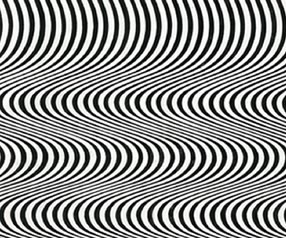
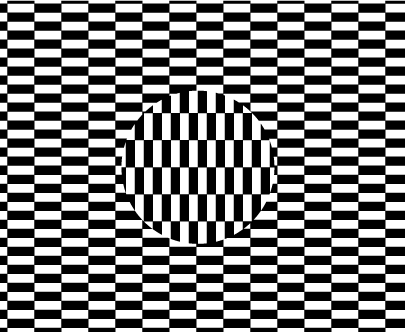
Q. The painting above by Bridget Riley (Current) and the piece below, referred to as the Ouchi Illusion, after the designer Hajime Ouchi, have something in common. What is it?


A. Both pieces challenge normal visual perception and both are extensions of abstraction. Notice that there is movement in these still pieces (which are not computer generated) and that they illicit a visceral experience when stared at a for any length of time. The “Op” in “Op Art” refers to the purely “optical” or “optic” nature of these pieces. Although Op Art was co-oped by the fashion world in the 60’s, and somewhat debased as a result, it is a culturally and artistically interesting movement. As noted by Sarah K. Rich in Artforum “compositional instability allegorized social flux. As objects changed and moved, viewers were coaxed into envisioning a society likewise capable of transformation.”

29

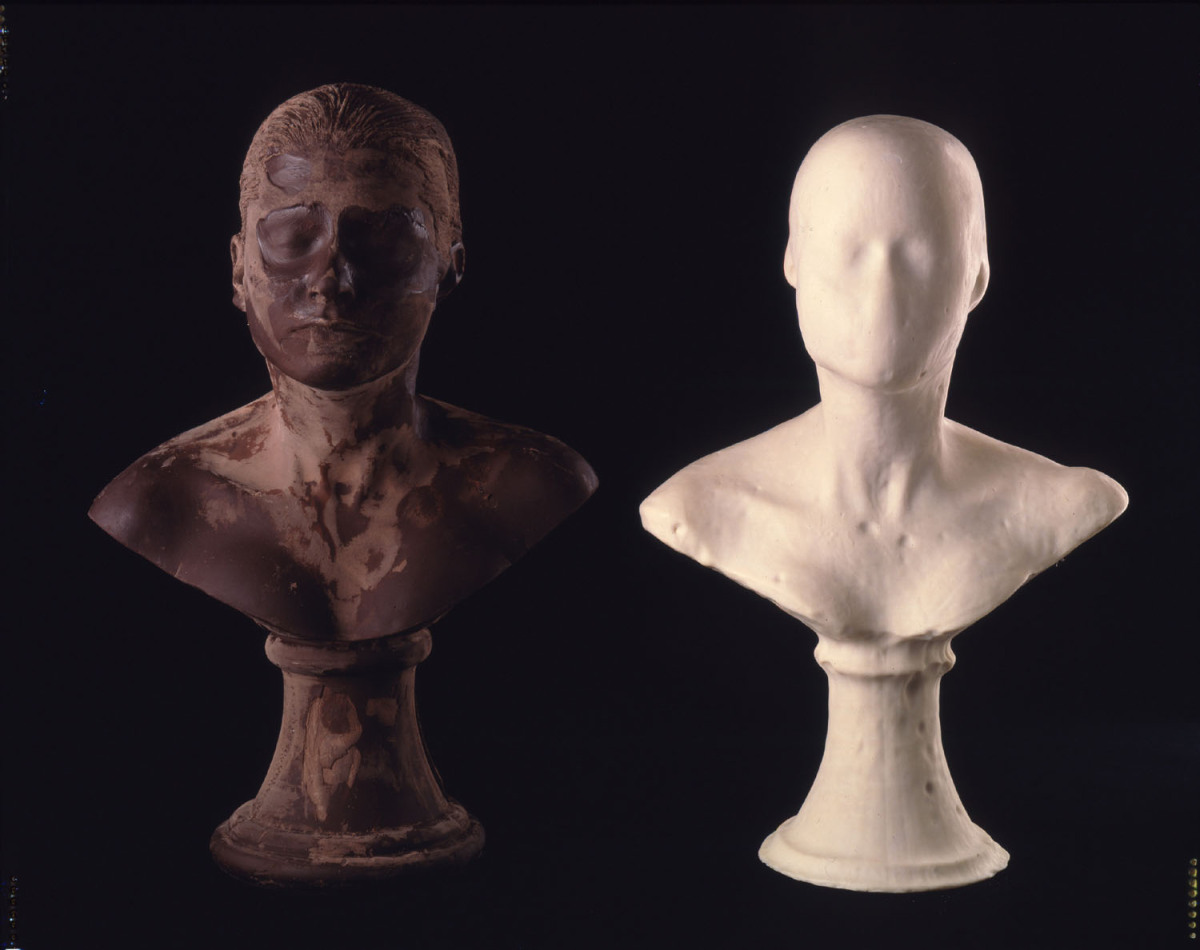
Q. These busts, by the artist Janine Antoni, are self portraits. One of them is made out of chocolate (which the artist has licked and bitten into) and the other is made of soap (which she has repeatedly washed with water). Why do you think she chose chocolate and soap as her materials?

A. Probably because she wanted to say something about pleasure and guilt, and the unrealistic, often conflicting but internalized female associations with virtue and vice. It is also, probably no coincidence, that one is black and one is white (because these are our fundamental color associations with good and evil).

30

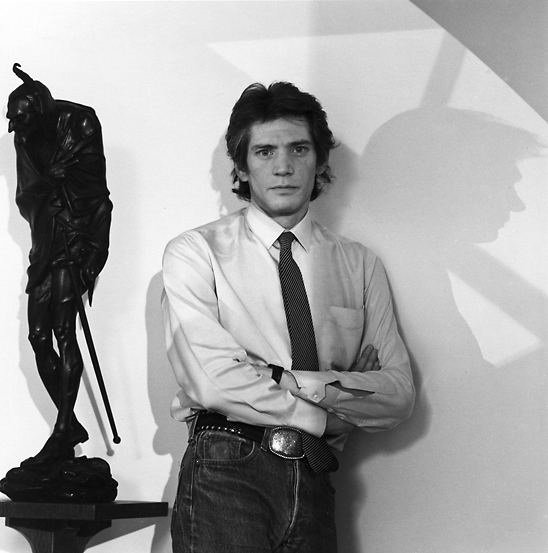
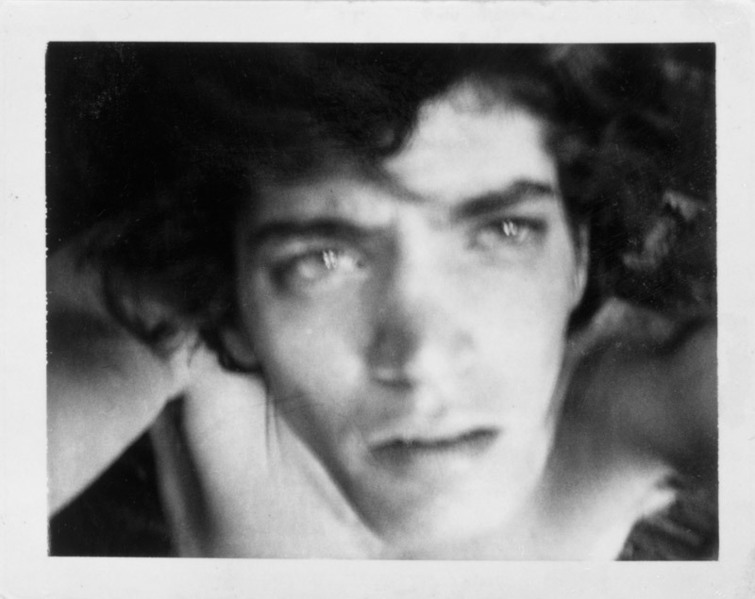
Q. What is the difference between a picture of someone’s likeness and a picture of their essence?

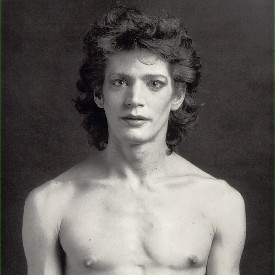
A. The image above is a very good image of Robert Mapplethorpe’s likeness – it shows us what he actually looked like in 1987.  Mapplethorpe’s self-portraits below are more intimate and unguarded and, therefore, provide access to his deepest self – or his essence. His self-portraits are intensely rich statements about who he was as a complex person.

Think back on all of the pictures that have been taken of you over the years (or which you have taken of yourself). Which ones express likeness and which ones express essence? How and why?