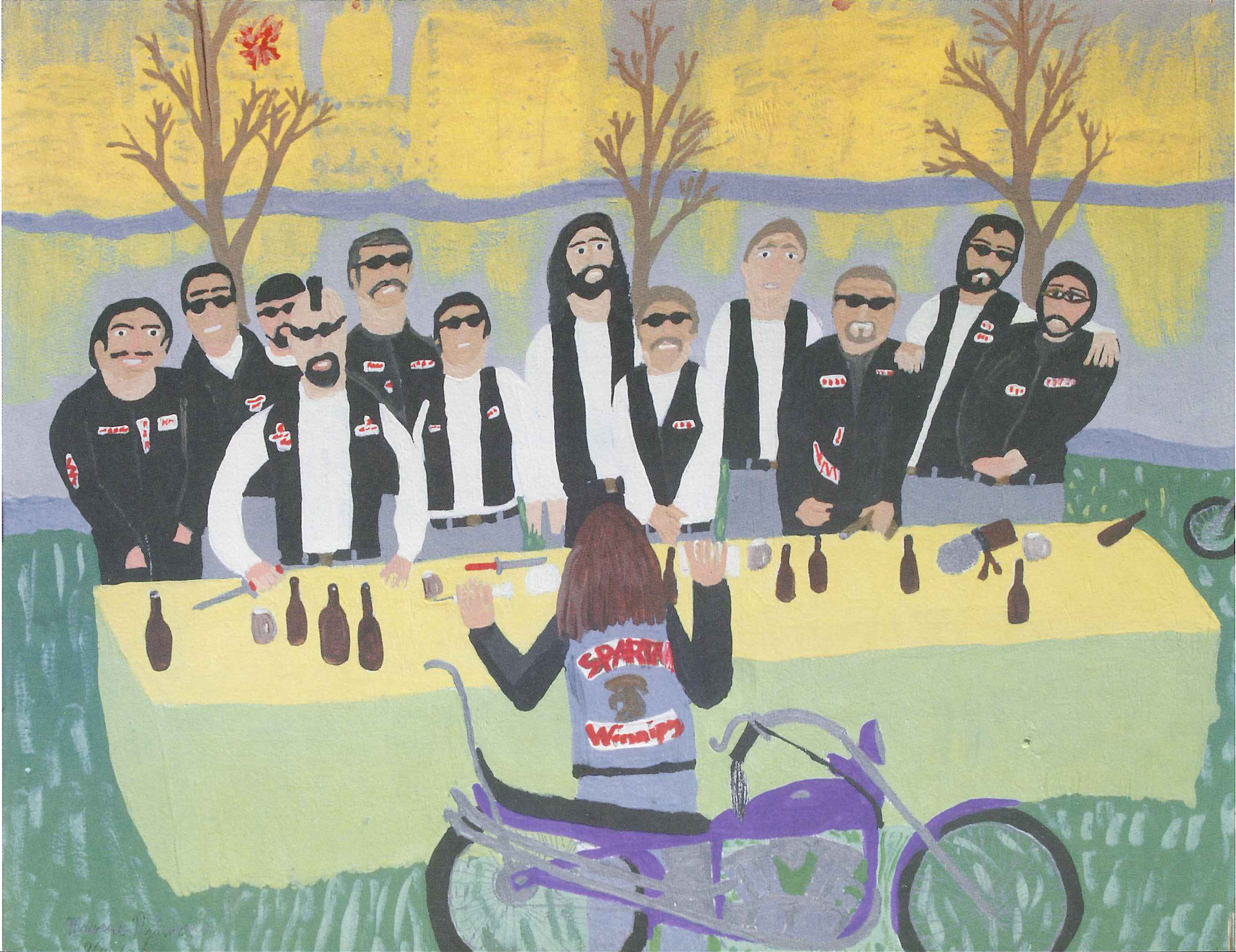
Q. What is the most humorous work of art you have ever seen?
A. You will, of course, have to answer this for yourself. Many works of art are very funny, and artists often use humor and satire to make a point. Lighten up the next time you visit a museum or gallery; looking at art is not always such a serious endeavor.
This painting by Maurice Dzama would be my choice. Who doesn’t love a bikers’ last supper?
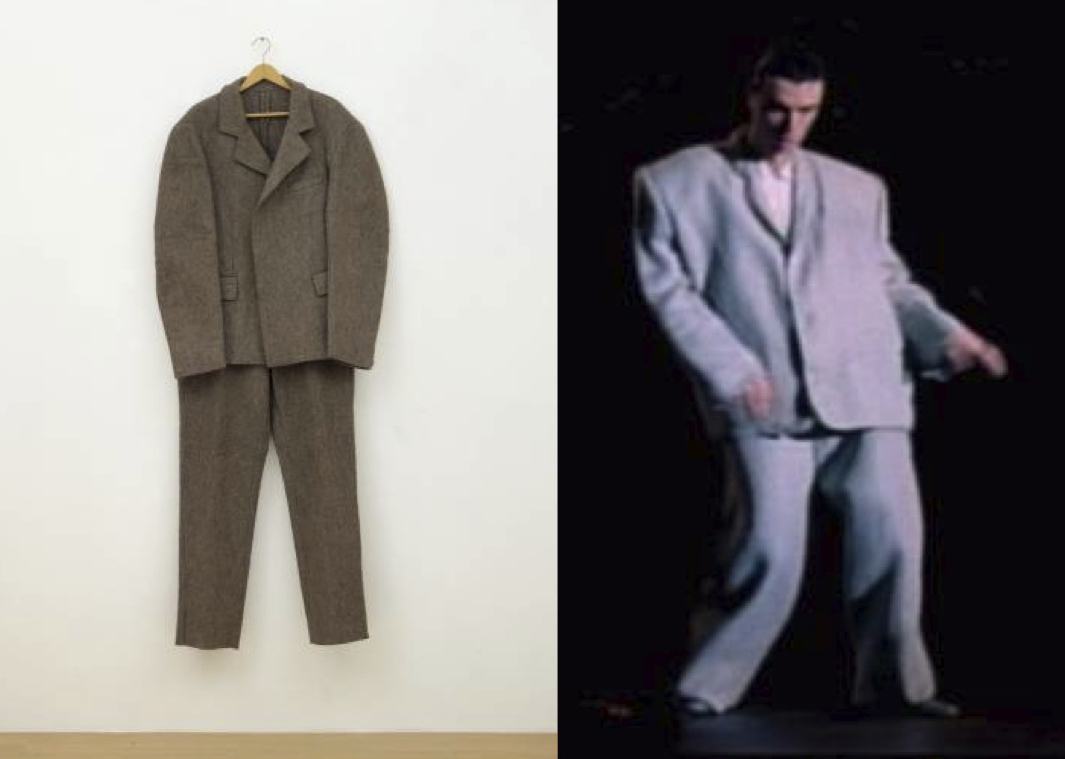
A. The suit on the left (made of felt) is the work of Joseph Beuys and the suit on the right (worn by David Byrne in the film Stop Making Sense) is a reference to Beuys’ original suit. The work of Joseph Beuys is complex beyond what can be explained here except to say that he used felt in many of his conceptual pieces as a symbol of spiritual protection and played with the idea that inanimate objects have magical qualities. Byrne has extended (and paid homage) to this idea by creating a suit that “grows” while he is performing. Byrne’s suit, like Beuys’ symbolic original, has a life of its own. This reference is included because it is somewhat different from the other references to fine art in popular culture which have been discussed previously. Byrne, himself a fine artist, is not “borrowing” from Bueys, he is referencing and extending the original idea…and essentially having a “conversation” with the original work of art.
Q. What visual cues are being used to heighten interest in this product?
A. This particular advertisement is visually activating a range of already well-developed sensory associations (sight, touch, smell, sound, taste). This is how each sense is activated:
Sight: This model looks like the candy itself – her hair is the color of the dark chocolate candy coating, her skin is milky white like the candy inside, and her eyes are mint green.
Touch: Because we see goose bumps on the model’s skin, there is a strong tactile quality to this ad. We don’t just “see” this attractive model eating candy; we can practically “feel” her eating it.
Smell: When we smell something good, the familiar and expected behavior is to close our eyes, which this model does to let us know her sense of smell is pleasantly aroused.
Sound: We also hear a “whooshing” sound and see wind blowing through the model’s hair. These are visual references to a brisk kind of freshness and to chilled air. This candy doesn’t just look, feel, and smell good: it sounds good too (and will blow your hair back).
Taste: All of these visual references are designed to direct our attention to a taste sensation…we “visually” taste the candy at the same time the model does. The visual cues are so strong and direct (and well-constructed) that we are able to connect with the exact flavor profile of this product – based, interestingly enough, on watching someone else eat it.
There are also visual hints that indicate that this candy is being eaten surreptitiously – she looks both ways before unwrapping the foil, bites her lip and quickly eats the last piece, making the experience of watching her eat it all the more exciting, because we become voyeurs to her private, sensual experience.
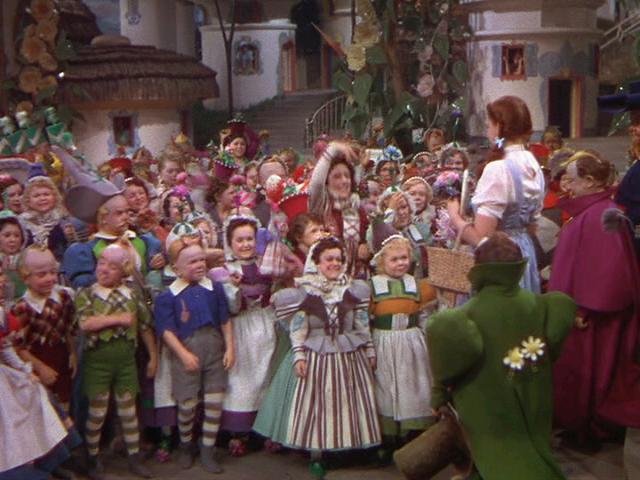
Q. How is color being used to support visual narrative in the film The Wizard of Oz?
A. Munchkinland provides a nearly perfect example of the way that color can be used to support and extend a visual narrative. It follows that Munchkin Land, which, like the Emerald city, is in the county of Oz, is a city of “gems”. That is why nearly everything in Munchkinland is based on a color palette of primary and secondary jewel tones. Dorothy’s dress references a blue sapphire and complements her ruby slippers and Glinda is the rare pink, glittering diamond.
A Mini Color Lesson: Color wheels are used to classify primary colors, secondary colors and intermediates (formed by mixing a primary and secondary color), and to group colors (warm and cool). Color is referenced as “hue” and is different from tonal values (light to dark) which are measured by gray scales.
Q. If a make-up artist sent you to the store to pick up a “cool” pink lipstick, which lipstick would you choose?
This is an applied color theory question. Although we are not always aware of it, most of us intuitively use some knowledge of color theory in many of our personal choices. When we buy make-up, color our hair, match a tie to a shirt, arrange colorful food on a dinner plate, or paint a room, we are (hopefully) using some basic understanding of color harmony to make appropriate selections.
Color wheels help us understand color relationships and interactions – or what happens when colors are grouped or mixed. According to color theory, warm colors (think sun) are yellow, red and orange (they appear to come forward), and cool colors (think snow) are blue, green and violet (they appear to slightly recede).
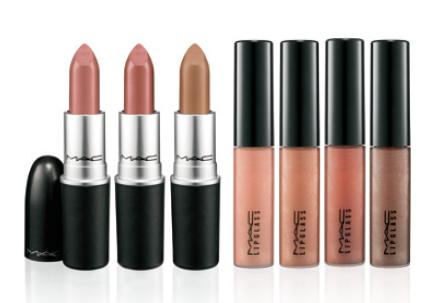
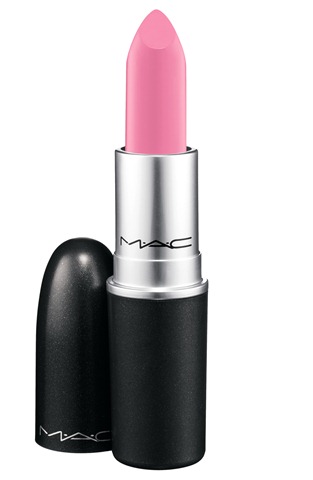
So, a pink lipstick, depending on its base color, can become either “cool” or “warm”. Don’t choose any of the pinks above – they have a gold base and are “warm” pinks; choose the pink below; it has a blue base making it a “cool” pink.
A. It turns out that there are quite a few. Researchers have enlisted children to help them locate the more rare varieties through a program called the Lost Ladybug Project. Species identification starts with a discerning eye that can “spot” (no pun intended) subtle differences and variations in pattern, shape and size.
Q. Have you ever seen a feature length film that relied mostly on visual imagery and not dialogue to tell a complex story?
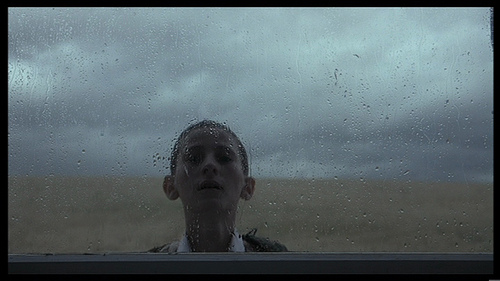
A. Although there are many to choose from, the film, Ratcatcher, by Lynne Ramsay, is a good place to start. While there is some minimal dialogue in this film, the narrative in primarily advanced through visual story telling. The story is set in Scotland during an historic garbage strike in the early 1970’s, creating an unusual backdrop of irresolution, neglect, and urban decay. In a poor neighborhood, as part of what appears to be normal roughhousing, the film’s protagonist, James, accidentally drowns another boy in a shallow canal outside their apartment building. James must find a way to incorporate this shattering event, and his own culpability for it, into his fragile sense of self. This is his story of grief and redemption. It is rich with images of water in all of its dual capacities to destroy and restore. This is an extremely complex and beautiful film and Ramsey’s elegiac imagery stays indelibly in one’s visual memory.
There are many others to check out, including The Match Factory Girl by Aki Kaurismaki and of course, the classic, The Red Balloon by Albert Lamrois.
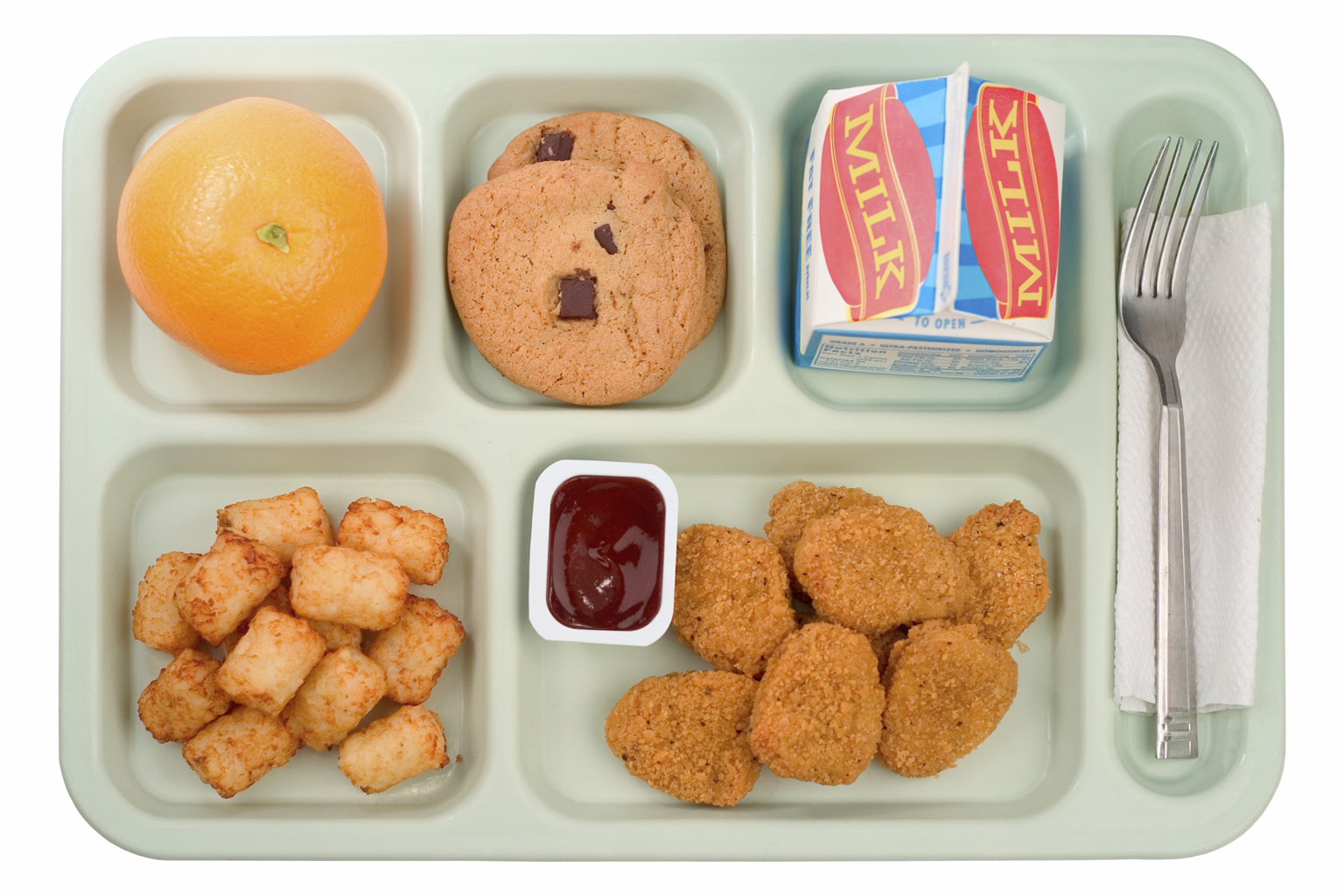
Q. Which would you rather eat, the Sheri Chen lunch or the school lunch?
A. Probably the Sheri Chen (Happy Little Bento) lunch because visual appeal is a major part of the pleasure of eating. Which is probably why we enjoy dining out; food is usually packaged and presented in ways that enhance the dining experience.
According to a study done at the Nestle Research Center, the appearance of food affects taste perception; “The individual’s (visual) evaluation of food, before it is eaten, is a crucial stage, not only for making nutritional choices, but for impacting the entire eating experience.”
Q. This painter has made a few “technical” mistakes. What are they and how do they affect our understanding of the painting?
A.There are some weird effects in this painting that come from errors in foreshortening and scale (her right hand is not well defined and her head is quite large in relation to her body). The grid on the wall also creates an odd, distorted effect (as though she were in a parallel universe). These “mistakes” however add a surrealist component to the image and make this portrait very special and interesting, particularly given that the subject’s gaze is so warm and direct. This image is from the book Thrift Store Paintings and was probably painted by an amateur painter. Perhaps it was discarded because of its imperfections.
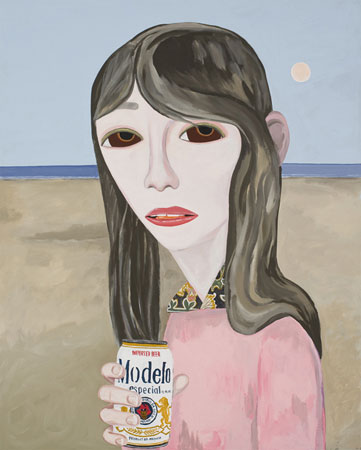
Now take a look at the painting below. This painting, entitled Head, is the work of a highly skilled artist named Brian Calvin. Similar manipulations of scale and foreshortening have been made (in this case intentionally) to emphasize a kind of sadness and personal alienation. The beer can, distant setting sun, and the large sad eyes tell the whole story.
This comparison is provided to demonstrate that whether they are made intentionally or unintentionally, manipulation of technique is a fundamental way artists gain creative control and develop an individual style – and throwing a wrench into the way we expect an image to look can have wonderful effects.
Q. Why do you think children are often good artists?
A. In part, due to their lack of experience and technical skill, they break many of the rules of drawing (perspective, foreshortening, scale, etc.) and in doing so they often make work that is unexpectedly fresh and visually fascinating. Also, it is my view that children are more likely to be free from visual cliche and are, therefore, able to access and communicate experiences and emotions that are startlingly genuine and original. Children are often frank and uninhibited when they draw and they tend to produce work that is powerful as a result.
For more on this subject read Making Sense of Children’s Drawings by John Willats. Willats asserts that “learning to draw is like learning a language, one of the major achievements of the human mind”.






 viqaiq.com